
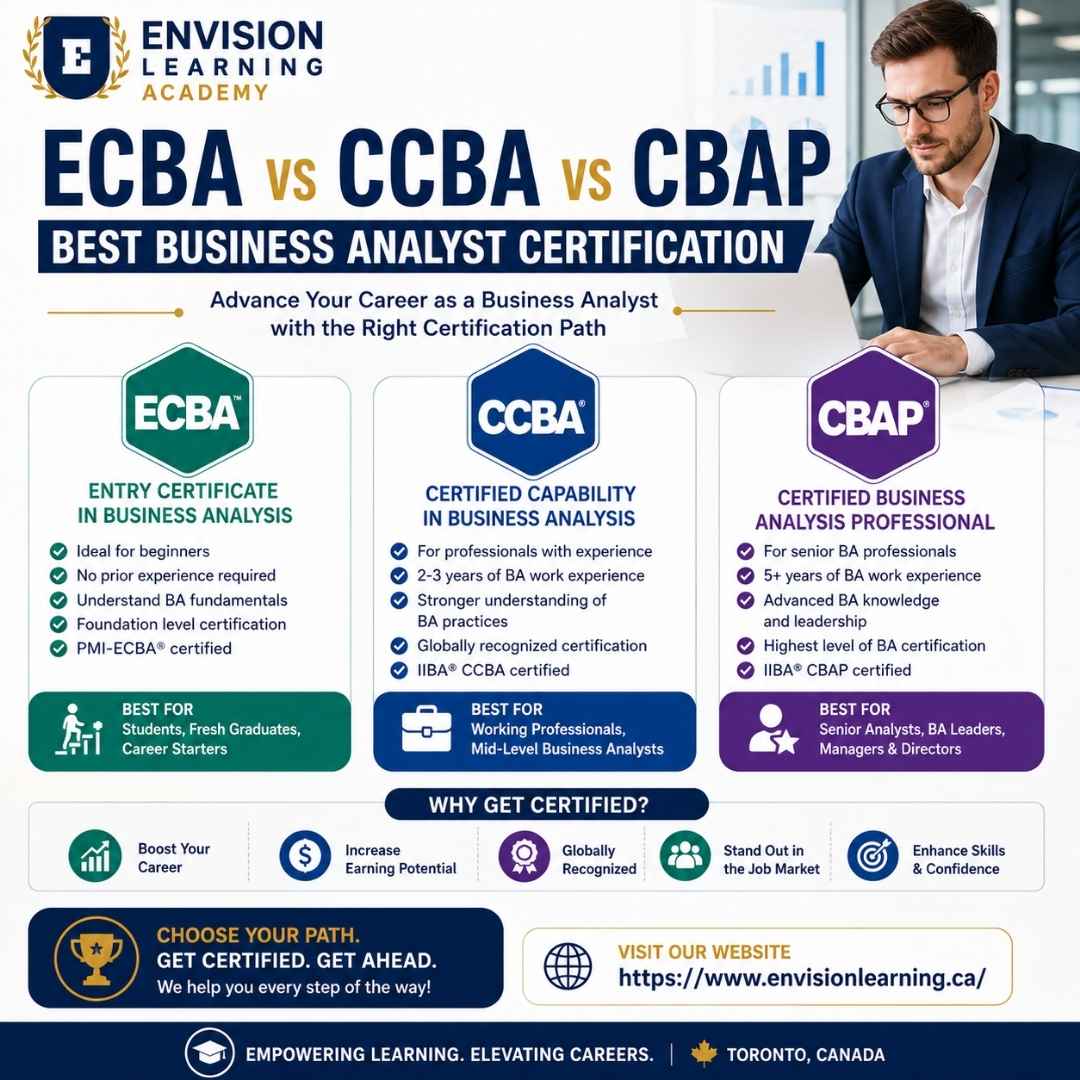
ECBA vs CCBA vs CBAP Which BA Certification Should You Choose
If you’re planning to build a career in business analysis, you’ve probably typed “ECBA vs CCBA vs CBAP” into Google more than once, trying to figure out where you actually stand. With three different
Business Analyst Certification paths from IIBA, it’s normal to feel a little lost about which one matches your experience level and career goals. This guide breaks down each certification in plain language so you can make a confident decision without wasting time or money on the wrong exam.
Whether you’re a fresh graduate trying to break into the industry, a mid-level professional looking to formalize your skills, or a senior BA aiming for global recognition, there’s a certification designed for exactly where you are. Let’s walk through each one so you can pick the right fit.
What Is IIBA Certification and Why Does It Matter?
The International Institute of Business Analysis (IIBA) offers a structured certification path that grows with your career. Instead of a single exam, IIBA created three levels — entry, intermediate, and advanced — so professionals at every stage have a credential that actually reflects their real-world experience.
Employers across Canada, the US, and globally recognize these certifications because they prove you understand core BA techniques like requirements elicitation, stakeholder management, process modeling, and solution evaluation. In a competitive job market, having a recognized credential next to your name can be the difference between getting shortlisted and getting overlooked.
ECBA Certification: The Starting Point for New Business Analysts
The ECBA Certification (Entry Certificate in Business Analysis) is designed for people with little to no prior BA experience. If you’re switching careers, just graduated, or are new to business analysis altogether, this is your entry point into the profession.
Who Should Take the ECBA?
- Recent graduates in business, IT, or related fields
- Career changers moving into business analysis from another domain
- Professionals with less than 2 years of BA experience
Key Requirements
- No prior work experience required
- 21 hours of professional development in the last 4 years
- A single exam covering the BABOK Guide fundamentals
The ECBA is ideal because it doesn’t require you to already have a BA job — it’s meant to help you get one. It validates that you understand the foundational vocabulary, techniques, and knowledge areas of business analysis, which makes your resume stand out even without years of hands-on experience.
CCBA Certification: For Professionals With Growing Experience
Once you’ve spent a few years actually working as a business analyst, the CCBA (Certification of Competency in Business Analysis) becomes the next logical step. It sits right in the middle of the IIBA certification ladder, bridging the gap between entry-level knowledge and advanced mastery.
Who Should Take the CCBA?
- BAs with 2–3+ years of hands-on experience
- Professionals who’ve contributed to real projects involving requirements gathering and stakeholder communication
- Those preparing to eventually pursue the CBAP
Key Requirements
- 3,750 hours of BA work experience in the last 7 years
- 21 hours of professional development
- Two professional references
- A comprehensive exam based on the BABOK Guide
The CCBA proves to employers that you’re not just familiar with BA theory — you’ve actually applied it. It carries more weight during salary negotiations and promotions because it demonstrates real project involvement, not just textbook knowledge.
CBAP Certification: The Gold Standard for Senior Business Analysts
The CBAP Certification (Certified Business Analysis Professional) is the most advanced and globally respected credential IIBA offers. It’s built for experienced professionals who have spent years leading complex BA initiatives and want recognition that matches their expertise.
Who Should Take the CBAP?
- Senior business analysts with 5+ years of experience
- Professionals managing large-scale requirements and stakeholder ecosystems
- Consultants and leads aiming for BA leadership or director-level roles
Key Requirements
- 7,500 hours of BA work experience in the last 10 years
- At least 900 hours in 4 of the 6 BABOK knowledge areas
- 35 hours of professional development
- Two professional references and a detailed application review
- A rigorous exam testing applied BA judgment, not just memorization
Earning the CBAP signals that you can operate at a strategic level — influencing business decisions, managing complex stakeholder relationships, and driving measurable outcomes. It’s often a prerequisite for senior BA, BA lead, or BA management roles across top companies.

ECBA vs CCBA vs CBAP: Side-by-Side Comparison
| Factor | ECBA | CCBA | CBAP |
| Experience Needed | None | 3,750 hours | 7,500 hours |
| Career Stage | Entry-level | Mid-level | Senior-level |
| Exam Difficulty | Foundational | Intermediate | Advanced |
| Ideal For | New BAs, graduates | Practicing BAs | Experienced BA leaders |
| Recognition | Growing | Strong | Highest |
This table makes the decision much simpler. If you’re just starting out, ECBA gets your foot in the door. If you’ve already got a couple of years under your belt, CCBA validates your practical skill set. And if you’re a seasoned professional, CBAP is the credential that opens doors to leadership positions.
How to Choose the Right Certification for Your Career Stage
Choosing between ECBA vs CCBA vs CBAP really comes down to honest self-assessment. Ask yourself:
- How many years of actual BA work have I done? If it’s zero to two, start with ECBA.
- Do I already work on real BA projects regularly? If yes, and you’ve crossed 2–3 years, CCBA is your next step.
- Am I leading initiatives, mentoring others, or managing complex stakeholder groups? If so, and you have 5+ years, CBAP is worth pursuing.
There’s no shortcut here — jumping straight to CBAP without the experience hours simply isn’t possible, since IIBA verifies your work history during the application process. It’s better to build your career step by step, letting each certification reflect genuine growth in your skills.
Career and Salary Benefits of BA Certifications in Canada
In Canada’s job market, particularly in cities like Toronto, Mississauga, and Brampton, certified business analysts consistently report better job prospects and stronger salary negotiations compared to non-certified peers. Canadian employers in banking, insurance, healthcare, and IT sectors often list IIBA certifications as a preferred (sometimes required) qualification in BA job postings.
Certified professionals also tend to move faster into senior roles, since these credentials give hiring managers measurable proof of skill rather than relying purely on interview performance. For newcomers to Canada or career switchers, an ECBA or CCBA certification can meaningfully speed up the job search process by signalling credibility to recruiters unfamiliar with your prior work history.
Final Thoughts
Deciding between ECBA, CCBA, and CBAP doesn’t need to be complicated once you understand what each certification is actually built for. ECBA opens the door for beginners, CCBA rewards those already doing the work, and CBAP recognizes true mastery at a senior level. Pick the certification that matches where you are today, not where you hope to be — the rest of your BA career will follow naturally as you grow into the next level.
If you want structured guidance, mock interviews, and hands-on training to prepare for any of these certifications alongside real job placement support, Envision Learning Academy offers dedicated Business Analyst training programs designed to help you move from certification to career with confidence.
Frequently Asked Questions (FAQs)
- What is the main difference between ECBA, CCBA, and CBAP?
The main difference is experiencing level — ECBA is for beginners with no BA experience, CCBA is for mid-level professionals with a few years of hands-on work, and CBAP is for senior BAs with extensive project leadership experience.
- Can I skip ECBA and go directly for CCBA or CBAP?
Yes, if you already meet the experience and hours requirements for CCBA or CBAP, you can apply directly without earning ECBA first. ECBA is optional but recommended for those with no prior background.
- How long does it take to prepare for these certifications?
Preparation time varies, but most candidates spend 6–10 weeks studying for ECBA, and 3–4 months preparing for CCBA or CBAP due to the added complexity and case-study-based questions.
- Which certification is more valuable in Canada — CCBA or CBAP?
CBAP holds slightly more weight for senior and leadership roles, but CCBA is highly valued for mid-level positions and is often the more practical next step for professionals with a few years of experience.
- Do I need a degree to apply for ECBA, CCBA, or CBAP?
No formal degree is mandatory, though a high school diploma or higher is typically required along with the specified professional development hours and, for CCBA/CBAP, verified work experience.
- How much does it cost to get IIBA certified?
Exam fees vary by membership status but generally range from around $130–$155 USD for ECBA, and higher for CCBA and CBAP, with additional costs for prep courses, study materials, and application processing.
Explore related articles: