
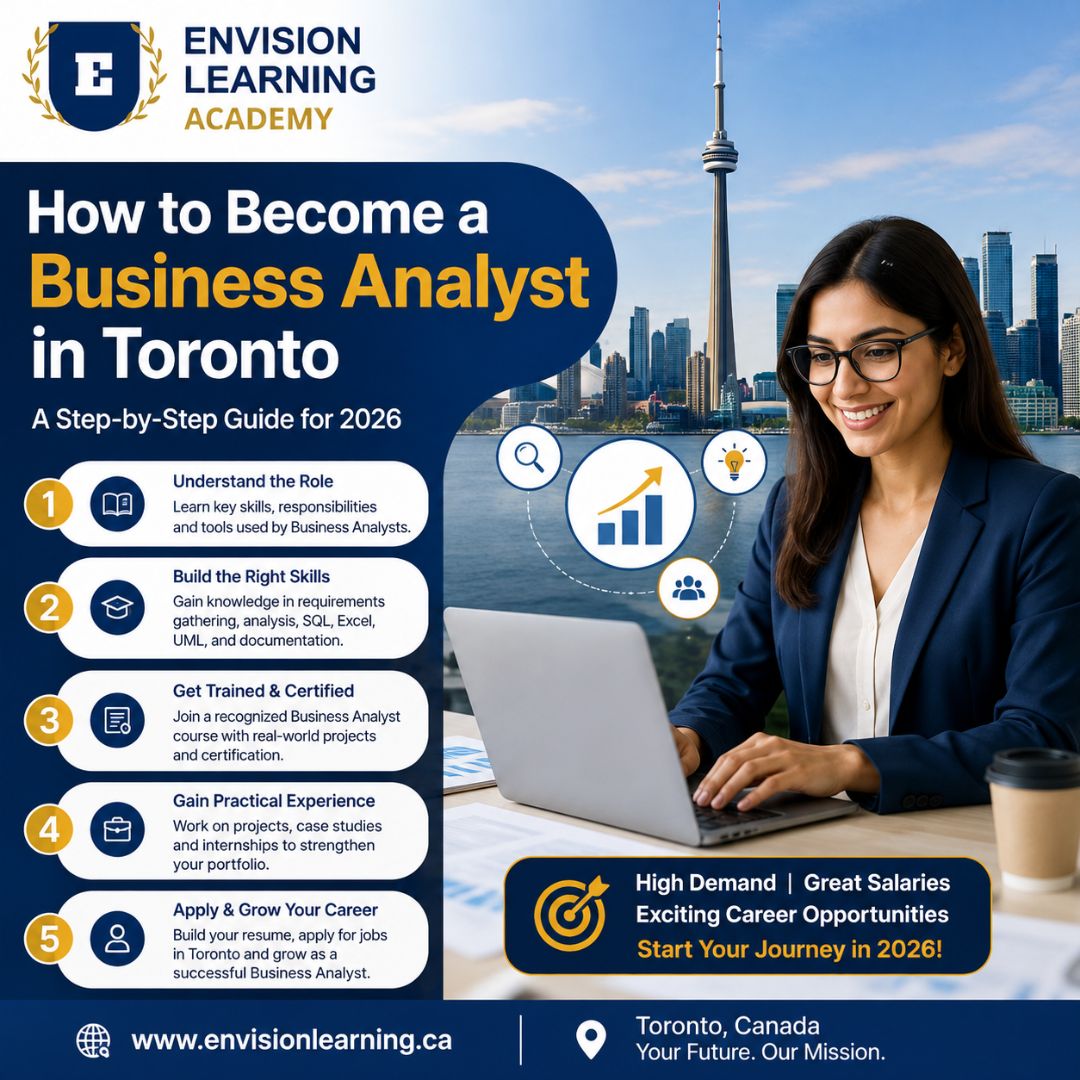
How to Become a Business Analyst in Toronto: A Step-by-Step Guide for 2026
Thinking about a career switch but not sure where to start? Becoming a Business Analyst in Toronto is one of the smartest moves you can make right now if you want stable pay, remote-friendly work, and a role
that doesn’t require a computer science degree. Companies across banking, healthcare, retail, and tech are actively hiring analysts who can bridge the gap between business needs and technical teams. If you’ve been searching for Business Analyst Training Toronto options or wondering what a Business Analyst Course Toronto actually teaches, this guide walks you through the entire journey — from your first skill to your first job offer.
Why Toronto Is a Hot Market for Business Analysts
Toronto sits at the center of Canada’s banking, insurance, and retail industries, and every one of those sectors runs on data-driven decision making. Business analysts are the people who sit between stakeholders and developers, translating messy business problems into clear requirements. Because of this constant demand, salaries have stayed competitive even as other tech roles slow down. Newcomers to Canada, career changers, and recent grads are all turning to this path because it doesn’t demand years of coding experience — just strong analytical thinking and the right training.
What Does a Business Analyst Actually Do?
Before jumping into training, it helps to understand the day-to-day. A business analyst gathers requirements from stakeholders, documents workflows, creates process diagrams, and works closely with QA and development teams to make sure a project actually solves the problem it was built for. You’ll spend time in meetings, writing documentation, running workshops, and occasionally testing features before they go live. It’s a role built for people who are naturally curious, organized, and good communicators — not just number crunchers.
Step 1: Build a Foundation in Business Analysis Concepts
Every strong analyst starts with the fundamentals: requirement gathering techniques, stakeholder management, and documentation standards like BRDs and use cases. You don’t need prior IT experience to start here. Most people entering this field come from customer service, retail management, teaching, or even hospitality backgrounds. What matters is your ability to listen carefully and translate what you hear into structured, actionable documents.
Step 2: Enroll in Structured Business Analyst Training
Self-study only gets you so far. A structured Business Analyst Training Toronto program gives you real project simulations, mentorship from working professionals, and a curriculum that mirrors what actual companies expect. Look for programs that combine theory with hands-on tools like JIRA, Confluence, and SQL, since almost every job posting in the city lists these as requirements. A good training program should also cover Agile and Scrum methodology, since most Toronto companies now run projects this way.
Step 3: Get Hands-On With Real Tools and Case Studies
Reading about business analysis is very different from doing it. The strongest candidates coming out of any Business Analyst Course Toronto are the ones who’ve worked through real case studies — writing user stories, building wireframes, running mock stakeholder interviews, and creating process flow diagrams. Employers can tell the difference between someone who memorized definitions and someone who has actually practiced the job. This hands-on stage is where confidence really starts to build.
Step 4: Earn a Recognized Certification
Once you’ve built practical experience, certification adds credibility to your resume. A Business Analyst Certification Toronto employers recognize signals that you’ve met an industry standard, not just completed a course. Certifications also give you a structured way to demonstrate specific competencies to hiring managers who are scanning dozens of resumes for the same role. While certification alone won’t land you a job, it does get your resume past automated screening tools and into human hands faster.
Step 5: Build a Portfolio That Shows Real Work
Toronto hiring managers want proof, not promises. Put together a small portfolio featuring a sample requirements document, a process flow diagram, and a short case study explaining a business problem you helped solve — even if it was part of a training simulation. This portfolio becomes your talking point in interviews and shows initiative that most entry-level candidates skip entirely.
Step 6: Polish Your Resume and Prepare for Interviews
Your resume needs to speak the language recruiters are scanning for — requirement gathering, stakeholder communication, Agile/Scrum, JIRA, UAT support, and process mapping. Beyond the resume, practice answering scenario-based interview questions like “tell me about a time you had to manage conflicting stakeholder requirements.” Mock interviews make a measurable difference here, since business analyst interviews rely heavily on situational judgment rather than technical tests.
Step 7: Network and Apply Strategically
Toronto’s business analyst community is active on LinkedIn, and many roles get filled through referrals before they’re even posted publicly. Attend local meetups, connect with alumni from your training program, and don’t underestimate the value of informational interviews with working analysts. A referral from someone inside a company can move your resume to the top of the pile instantly.
Training and Job Placement Support
Getting trained is only half the equation — the other half is turning that training into an actual job offer. This is where Envision Learning Academy fits into the picture, offering hands-on business analyst training paired with resume support, mock interviews, and direct connections to hiring partners across the GTA, so graduates aren’t left figuring out the job search alone after finishing their coursework.
Frequently Asked Questions
- Do I need a degree to become a business analyst in Canada?
No formal degree is required in most cases. Employers care more about your ability to demonstrate requirement-gathering skills, communication, and relevant training or certification than your academic background.
- How long does it take to become a business analyst in Toronto?
Most structured training programs run between 8 and 12 weeks, though building enough confidence for interviews and landing your first role can take a few months of consistent effort.
- What is the average business analyst salary in Canada?
Entry-level analysts in major Canadian cities typically start in the $55,000–$70,000 range annually, with experienced analysts earning significantly more depending on industry and specialization.
- Is business analysis a good career for newcomers to Canada?
Yes, it’s one of the more accessible entry points into the IT industry for newcomers, since it emphasizes communication and analytical skills over Canadian-specific technical experience.
- What skills do employers look for in a business analyst?
Requirement documentation, stakeholder communication, Agile/Scrum familiarity, basic SQL, process mapping tools, and strong problem-solving ability top most job postings.
- Can I become a business analyst without an IT background?
Absolutely. Many successful analysts come from retail, customer service, healthcare, or admin roles, since the core skill set is analytical thinking and clear communication, not coding.
- Is certification necessary to get hired as a business analyst?
It’s not always mandatory, but certification does help your resume stand out and pass automated applicant tracking systems that many larger Canadian companies use during hiring.
Final Thoughts
Becoming a business analyst in Toronto is a realistic, achievable goal in 2026 for anyone willing to put in structured effort. The path is clear: build your foundational knowledge, get hands-on practice, earn recognized certification, and prepare a resume and portfolio that actually reflects your abilities. With the right training and consistent networking, you can move from complete beginner to job-ready analyst faster than most people expect.
Explore related articles:
Data Analyst Training Toronto with Certification and Job Placement
Best Data Analyst Training with Certification and Career Support