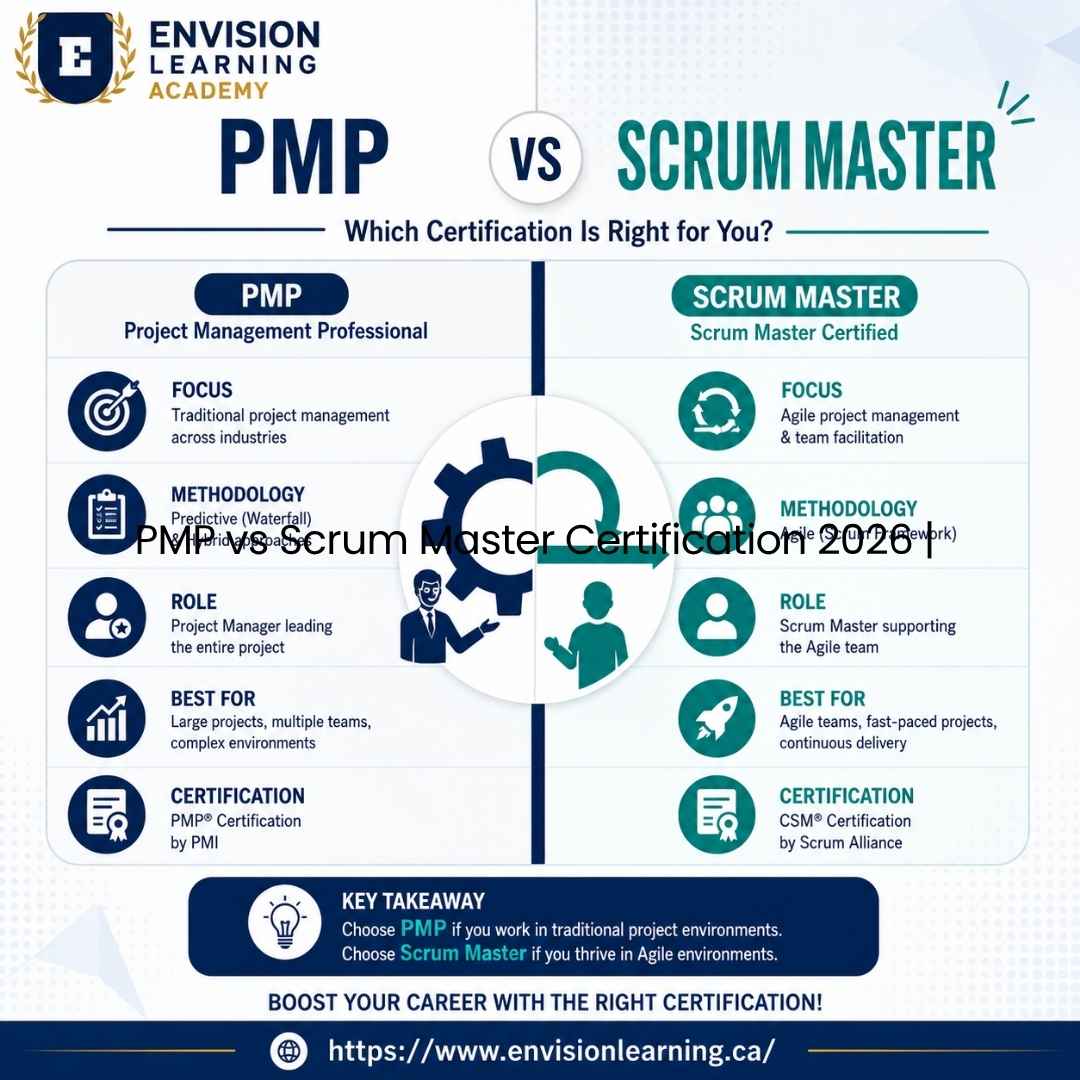
PMP vs Scrum Master: Which Certification Should You Get First in 2026?
Choosing between two career-changing credentials can feel overwhelming, especially when both promise better pay, faster promotions, and stronger job security. PMP vs Scrum Master is one of the most searched comparisons among project management
professionals in 2026, and for good reason — both certifications open doors, but they lead down very different career paths. If you’re planning your next move in project or product delivery, understanding the real differences between a PMP Certification 2026 and a Scrum Master Certification will save you time, money, and a lot of second-guessing.
This guide breaks down what each certification actually teaches, who it’s best suited for, how much you can expect to earn, and — most importantly — which one you should pursue first based on your career goals.
What Is PMP Certification?
The Project Management Professional (PMP) credential, offered by the Project Management Institute (PMI), is widely regarded as the gold standard for traditional and hybrid project management. It validates your ability to lead projects from initiation through closure, covering budgeting, risk management, stakeholder communication, and scheduling across industries like construction, IT, healthcare, and finance.
PMP is built around a predictive (waterfall) approach to managing work, though recent updates to the exam also test agile and hybrid methodologies. To sit for the exam, candidates typically need a combination of a four-year degree plus 36 months of project leadership experience, or a high school diploma/associate degree plus 60 months of experience, along with 35 hours of project management education.
Because of its rigorous eligibility requirements and exam difficulty, PMP tends to appeal to professionals who are already managing complex, multi-phase projects and want formal recognition of that experience.
What Is Scrum Master Certification?
A Scrum Master Certification, such as the Certified ScrumMaster (CSM) or Professional Scrum Master (PSM), focuses on agile software and product development. Instead of managing every detail of a project, a Scrum Master acts as a facilitator — removing obstacles, coaching teams on agile principles, and ensuring the Scrum framework (sprints, daily stand-ups, retrospectives) runs smoothly.
Unlike PMP, most Scrum Master certifications have no strict prerequisites. You don’t need years of experience or a specific degree to get started, which makes it a popular entry point for people transitioning into tech, IT, or agile-driven workplaces. The certification exam is also generally shorter and less intensive than the PMP exam, making it achievable in a matter of weeks rather than months.
Key Differences Between PMP and Scrum Master
| Factor | PMP | Scrum Master |
| Methodology | Predictive/hybrid | Agile |
| Experience required | Yes (3–5 years) | Usually none |
| Exam difficulty | High | Moderate |
| Best for | Senior project leads | Team facilitators, agile coaches |
| Industries | Construction, IT, healthcare, finance | Software, tech, product teams |
| Time to certify | Several months | A few weeks |
The core distinction comes down to scope and mindset. PMP prepares you to own an entire project lifecycle across virtually any industry. A Project Management Certification like PMP signals that you can manage budgets, timelines, and stakeholders at a senior level. Scrum Master certification, on the other hand, prepares you to lead a single team through iterative, fast-moving development cycles — a skill set increasingly in demand as more companies adopt agile ways of working.
Which Certification Should You Get First?
For most professionals, the right starting point depends on three things: your current experience level, your target industry, and your long-term career goals.
Choose Scrum Master first if:
- You’re early in your career or switching into IT/tech
- You don’t yet meet PMP’s experience requirements
- You want a faster, lower-cost credential to build momentum
- Your target companies use agile or Scrum frameworks
Choose PMP first if:
- You already have 3+ years of project leadership experience
- You work in industries like construction, engineering, or finance where waterfall methods dominate
- You want to qualify for senior project manager or program manager roles
- You’re aiming for higher long-term salary ceilings
A common and highly effective strategy in 2026 is to earn a Scrum Master certification first to gain practical, hands-on agile experience, then pursue PMP once you’ve accumulated enough project leadership hours to meet the eligibility criteria. This sequencing lets you build real-world credibility while working toward the more advanced credential.

Salary and Career Growth in 2026
Both certifications continue to show strong demand across Canada and globally. PMP holders often command higher average salaries due to the seniority and cross-industry demand associated with the credential, while Scrum Masters frequently see faster salary growth early in their careers as agile adoption expands across sectors beyond tech, including banking, retail, and healthcare.
Employers increasingly value professionals who hold both — a PMP for strategic oversight and a Scrum Master certification for agile team leadership. This “hybrid skill set” is becoming a competitive differentiator for candidates applying to project and product management roles in Canada’s growing tech and financial sectors.
PMP vs Scrum Master: Making the Right Choice for Canada’s Job Market
Canada’s IT and project management job market has seen sustained demand for both credentials, particularly in cities with strong tech and financial hubs like Toronto, Mississauga, and Brampton. Many Canadian employers, especially banks, telecoms, and IT consulting firms, look for candidates who understand both traditional project delivery and agile team facilitation. This means newcomers to Canada and career changers often benefit most from starting with the more accessible Scrum Master Certification before layering on a PMP once they’ve built local project experience.
Frequently Asked Questions
- Is PMP or Scrum Master better for beginners?
Scrum Master certification is generally better for beginners since it has no strict experience prerequisites and can be completed in a few weeks, making it a faster entry point into project and product management careers.
- Can I get both PMP and Scrum Master certifications?
Yes, and many professionals do. Holding both credentials demonstrates versatility across agile and traditional project management, which is increasingly attractive to employers managing hybrid teams.
- Which certification pays more, PMP or Scrum Master?
PMP holders typically report higher average salaries due to the seniority and broader industry applicability of the credential, though Scrum Masters in high-demand tech markets can see comparable or faster early-career salary growth.
Start Your Certification Journey Today
Whether you’re leaning toward PMP, Scrum Master, or planning to eventually earn both, the most important step is getting proper, structured training from experienced instructors who understand what Canadian employers are actually looking for. Envision Learning Academy offers hands-on PMP Exam Training and Scrum Master Certification courses designed to get you job-ready, with real-world project scenarios, resume support, and dedicated job placement assistance. If you’re ready to take the next step in your project management career, reach out to Envision Learning Academy today to find the certification path that fits your goals.
Explore related articles:
Weekend IT Training in Mississauga and Toronto for Career Growth